
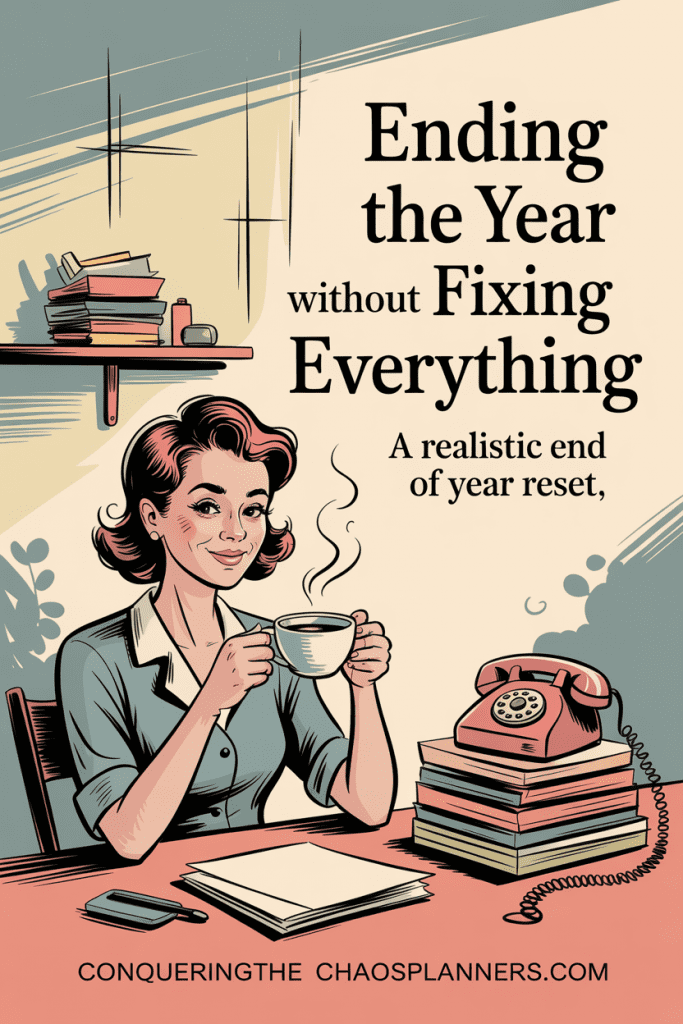
Somehow, the end of year reset became a finish line.
Not because anything magical happens on December 31—but because we collectively decided it does.
We start saying things like:
- I want this done by the end of the year.
- I’ll feel better once this year is wrapped up.
- January will be easier if I just push through.
Which is… an interesting theory.
December 31 didn’t volunteer to be a life deadline.
It’s just a date we’ve loaded with way too much emotional responsibility.
And that’s how an end of year reset turns into pressure instead of relief.
Why We Treat the End of the Year Like a Turning Point
For some reason, we expect an end of year reset to deliver closure.
Once the calendar flips, unfinished things start feeling urgent.
Projects feel overdue.
Loose ends get louder.
Even normal life admin starts acting like a personal failure.
So we rush.
We overcommit.
We try to fix things that don’t actually need fixing.
Not because it’s helpful—but because “the year is ending.”
How Unrealistic Expectations Ruin an End of Year Reset
This is where end of year reset expectations go sideways.
We pile on goals like:
- Finish what you avoided all year
- Get organized for real
- Start January as a totally new person
When that doesn’t happen, we don’t question the expectation—we blame ourselves.
You didn’t fail your end of year reset.
You just tried to compress a full life cleanup into December.
Why Perfection Is the Wrong Goal for an End of Year Reset
A realistic end of year reset isn’t about perfection.
It’s about ease.
Ease means fewer mental tabs open.
Less background noise.
Fewer “I’ll deal with that later” thoughts hanging over your head in January.
Here’s what that looked like for me.
One of my personal end of year reset projects is getting all my photos off my phone and into Amazon Photos so everything lives in one place. Family pictures. Memories. The stuff that actually matters.
That part? Done.
What’s not done is dealing with the 333 recipe screenshots still on my phone.
I swear that is not an exaggeration.
No, I do not have a system.
And that’s fine.
Because the photos mattered more than perfectly organizing screenshots of recipes I might make someday.
What a Realistic End of Year Reset Actually Looks Like
A useful end of year reset doesn’t try to fix everything.
It focuses on what makes life easier—and stops there.
Choose What Matters Most
Not what sounds impressive.
Not what guilt tells you to handle.
Not what feels like the “right” thing to reset.
I chose family photos over recipe screenshots because that was the part that mattered most to me.
That one decision reduced mental clutter immediately.
Give Yourself Permission to Stop Early
This is the most underrated part of an end of year reset.
I stopped once the photos were done.
I didn’t force myself to invent a system for 333 screenshots because thinking about it gave me a headache.
They’re still there.
And I trust that when a solution finds me, I’ll deal with them then.
Stopping early wasn’t failure—it was strategy.
Remember That Done > Perfect
Mostly done counts.
Good enough counts.
Better than last year absolutely counts.
Especially in December.
If You Want Help Deciding What’s Worth Doing
This is usually the moment people get stuck.
Not because they don’t want an end of year reset —
but because they don’t know what’s actually worth touching and what can wait.
That’s exactly why I created the New Year Reset Checklist.
It’s not a “do all of this before January” list.
It’s a short, practical menu of things that tend to quietly nag at us — the stuff that makes January feel heavier than it needs to be.
You don’t do all of it.
You pick what helps.
You leave the rest.
Get the New Year Reset Checklist
Close the Year Without Forcing a Perfect Reset
The end of the year doesn’t need a dramatic wrap-up.
You don’t need to fix everything.
You don’t need closure on every loose end.
You don’t need a picture-perfect end of year reset.
You just need less mental noise.
When you stop treating December like a deadline, January starts with more space.
And space—not perfection—is what actually makes an end of year reset work.
If the checklist helps you clear even one thing that’s been quietly hanging over you, it did its job.
Pick what helps.
Leave the rest.
And let the year end without making it a whole thing.
Most Recent Posts:
Get Caught Up Here
- Why a New Year Reset Checklist Makes January Feel Easier
- Feeling Overwhelmed When Nothing Is Wrong? Why Life Feels Like Too Much
- How Background To-Dos Create Mental Clutter
- No Goals for New Year? Why Starting Without Goals Can Actually Help
- Why the Days Between Christmas and New Year Feel So Weird (and What Actually Helps)
- Closing the 100 Days ’Til Christmas Series
- One Last Minute Christmas Planning Sesh Before You Let It Go
