Sometime in late May or early June, you make a list.
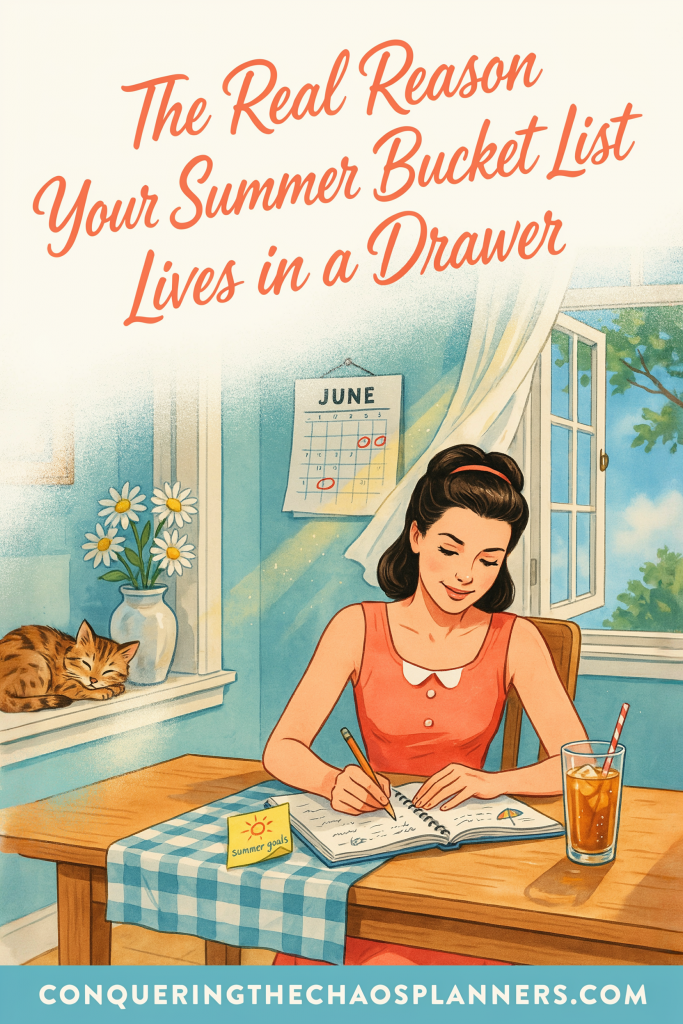
Maybe it’s on your phone. Maybe it’s in a notebook. Maybe it’s a sticky note on the fridge that says “summer goals” with a little sun drawn next to it.
The peach orchard. The day at the lake. Brunch with your friend you keep rescheduling. The outdoor concert you always say you’ll go to and never do. The slow Saturday morning. The trip. The dinner. The hike.
You make the list and something about making it feels good. Like summer is already more possible than it was before.
And then — you know how this goes — August arrives. You find the list. You do the quiet calculation of what happened and what didn’t.
Most of it didn’t.
And here’s the part that’s hard to explain: it’s not that you forgot. It’s not that you didn’t care. It’s not that the summer was bad. Life just happened, and the list didn’t.
That’s not a willpower problem. That’s a location problem.
(If you’ve ever wondered why summer always feels like it’s over before it started, this is usually the piece that explains it.)
The List Is Not the Problem
Before we go any further — the list you made was probably a good one.
Real things. Things you actually want. The peach orchard isn’t aspirational nonsense. Brunch with your friend isn’t a Pinterest fantasy. The lake day, the concert, the slow Saturday — those are the things summer is actually made of, and you knew that when you wrote them down.
Most summer bucket lists are made by people who genuinely want those things to happen. Not people who are delusional about summer, or overly optimistic, or bad at planning. People who just want the summer to actually feel like summer.
That’s allowed.
So if the list disappears into August with most of it unchecked, the problem isn’t that you made a bad list. It isn’t that you chose the wrong things. It isn’t a character flaw or a planning failure or proof that you’re not someone who follows through.
The list you made was fine. The list isn’t why summer disappears.
Something happens to the bucket list after it gets made. And that’s the part nobody really talks about.
Here’s what happens to a bucket list that lives only on a list.
Here’s What Actually Happens to a Bucket List
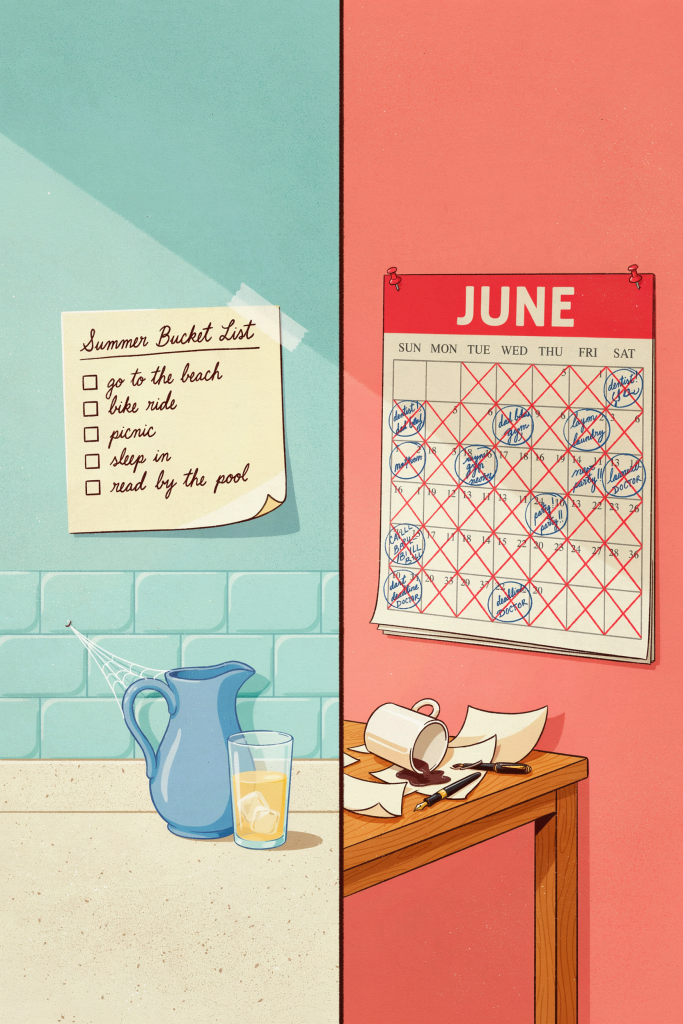
A list on paper has no relationship with the calendar.
Those are two completely separate places. And life — your real, actual life — happens on the calendar. Or in the cracks between calendar things. Or in the sudden open Saturday afternoon that nobody planned for. But not on the list. Never on the list.
The calendar fills up on its own. It doesn’t ask permission. It doesn’t check what’s on the bucket list before claiming a weekend. The dentist appointment lands. The thing someone needed lands. The Saturday that was supposed to be free turns into a birthday party you forgot about and a grocery run and one errand that became three.
None of those things are bad. They’re just things. They just showed up first.
The bucket list doesn’t compete with any of that. It just sits there — available in theory, waiting to be remembered, completely unconnected to any specific day. It doesn’t have a Tuesday. It doesn’t have a weekend in July. It has no claim on any particular afternoon at all.
Here’s how it goes: June arrives and you think, I could do the lake day this weekend. And then the weekend fills up. And you think, next weekend. And then something about next weekend. And then it’s July, and you think, we still have time. And you do — technically. But the lake day doesn’t have a date. It never got a date. It’s still just living on the list, being something that could happen, waiting for a day to claim it.
By the time August arrives, the bucket list hasn’t moved to the calendar. The calendar has just moved through the summer. Two documents, same season, never speaking to each other.
That’s what “summer slipping by” actually is. Not negligence. Not failure. Just a list and a calendar that were never introduced.
(This is also, by the way, exactly how the mental load works — the things that matter most stay floating in your head or on a piece of paper, unattached to any moment where they can actually happen.)
The One Move That Changes Everything

Think about two versions of the exact same bucket list. Same items. Same handwriting, even. Same peach orchard, same brunch, same lake day, same outdoor concert.
One version stays on the page.
One version gets placed on the calendar. Not all of it — not every single thing scheduled down to the hour. But enough of it that specific items have specific weeks. The lake day has a Saturday in July with your name on it. Brunch has a date that got texted to your friend. The concert has a weekend that’s been marked. The things that matter have a place to actually happen before the calendar fills in around them.
Only one of those versions has any power over what actually happens in June, July, and August.
A bucket list that lives only on a list is decoration. A bucket list that lives on the calendar is a plan.
That’s it. That’s the whole thing. It’s not about making a better list. It’s not about wanting summer more or trying harder or being more intentional. It’s about whether the things on your list exist somewhere that the calendar can see them — before everything else fills in and the summer just passes.
Items on the calendar get protected. Items on a list get noticed in August.
The list isn’t the problem. Where you’re keeping it is.
Start Here
If this landed — if you’ve made a bucket list in June and found it in a drawer in August — I built something that fixes the location problem.
It’s called the Summer Home Blueprint. It’s a short, workbook-based course that walks you through making the summer bucket list ideas that actually fit your family, placing them on the calendar where they can actually happen, and building the simple weekly habit that keeps the calendar connected to the summer you wrote down.
It’s not a goal-setting system. It’s not a productivity course. It’s the specific set of tools that takes the bucket list off the page and puts it where the calendar can see it.
