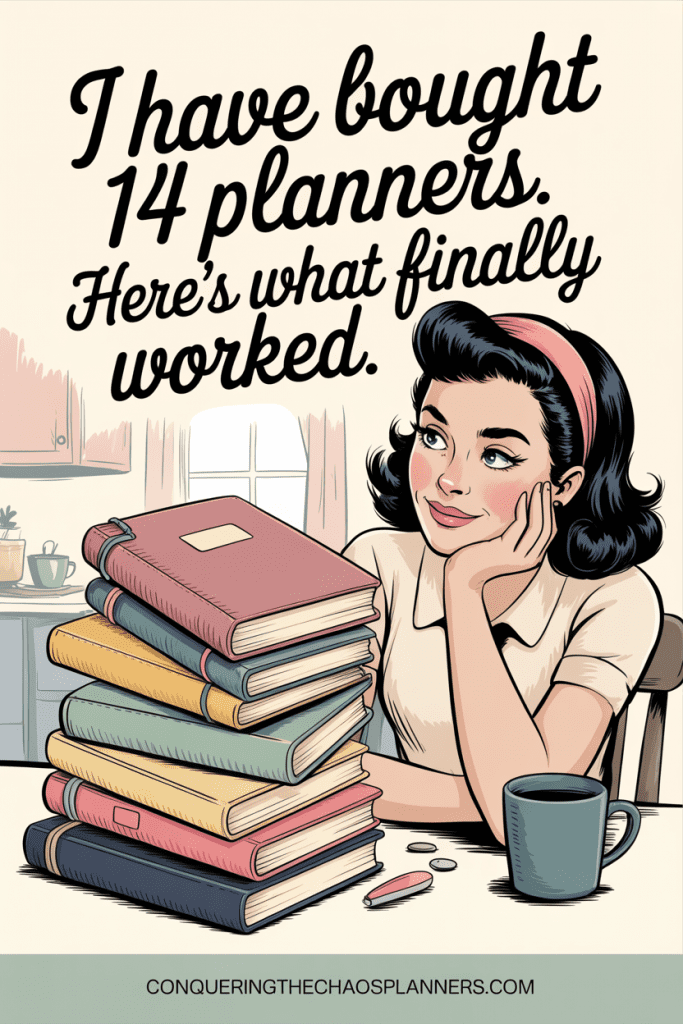
I have bought somewhere around fourteen planners. I was looking for the best planner that actually works. I never found it on a shelf.
That’s not a guess. I went through my Amazon order history once, several years ago, and counted. Then I closed the browser and pretended I hadn’t.
There was the Erin Condren. The Hobonichi. The Day Designer. The bullet journal phase that lasted exactly five weeks. The Passion Planner. A handful of apps — Trello, Notion, ToDoist, one called Sunsama that I used for nine days. A printable from Etsy I never actually printed.
Each time I bought one, I had the same conviction: this is going to be the one.
And every single time, the same thing happened. I’d use it for a few weeks. It would work. Then life would get manageable, and the planner would slowly migrate off my desk and into a drawer. Then a few months later, overwhelm would creep back in, and I’d start looking again.
Here’s what I want to tell you, because it took me embarrassingly long to figure out: the problem was never the planner.
The Planners I Bought (And Abandoned)
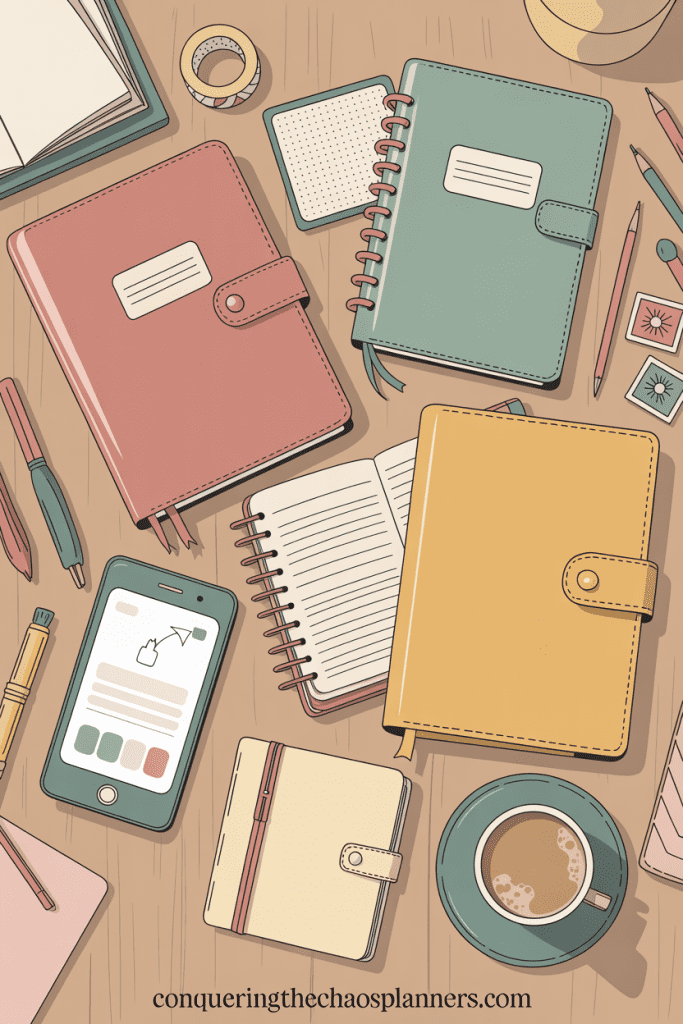
The Erin Condren came first. I’d seen them on Pinterest for months — the laminate cover, the colorful tabs, the optional add-ons, all the influencers showing off their setups. I spent a weekend in 2018 setting one up. Stickers. Page flags. A color-coded system for everything — work in blue, kids in orange, personal in green, appointments in pink. By week three I was using it as a notebook for grocery lists. By week six it was on the bookshelf.
The bullet journal phase came next. I bought the dot grid notebook and the pens and the ruler. I watched maybe twenty YouTube videos about spreads. The first week of layouts took me four hours and they looked great. The second week’s layouts took me two hours and they looked okay. By the third week I was migrating tasks I hadn’t done because I’d spent all of my planning time drawing the calendar instead of using it. Five weeks in, the notebook went into the same drawer as the Erin Condren.
Then came the apps. Trello, because a friend swore by it. Notion, because everyone on the internet swore by it. ToDoist, because I’d given up on Notion. Sunsama, because I’d read a thoughtful article about intentional planning and the screenshots looked calming. I lasted nine days on Sunsama. The thing I remember most is that I kept opening the app to plan my day, and then closing it without ever looking at it again during the day.
I’m leaving out the printable from Etsy that I bought, didn’t print, and forgot about until it showed up in an Amazon order email two years later. And the Passion Planner that I’d set aside for “when I had more time to fill it in properly.”
The pattern is so obvious when I lay it out like this. It was not obvious to me at the time.
The Pattern I Didn’t See For Years
For years, I assumed I was just bad at this. That I lacked discipline, or focus, or whatever the thing was that other women had and I didn’t. The planner in the drawer was evidence. The fourteen planners in the drawer were fourteen pieces of evidence.
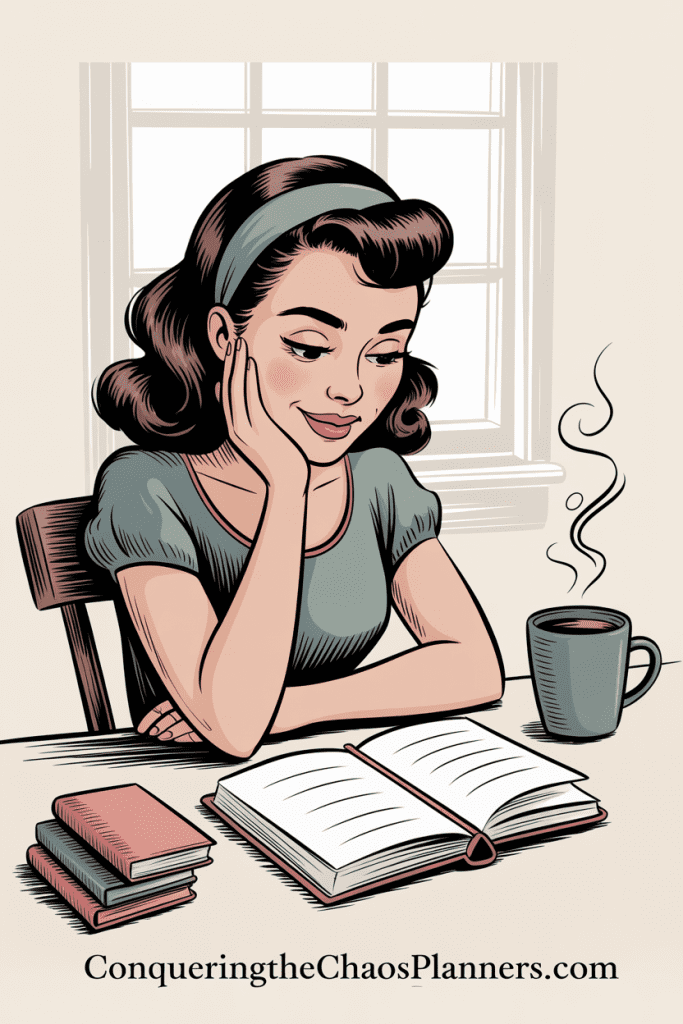
Then one day — and I genuinely cannot remember what triggered it — I was at my desk looking at the planner I was currently failing to use. I want to say it was a Tuesday. I had coffee. The planner was open to a week where I had filled in Monday and then nothing else. And I looked at it, and I noticed something I had somehow never noticed before.
It was the third planner I’d bought that year. The previous two were almost identical to each other. And both of those were almost identical to the planner I’d carried in middle school — the one with the little flowers on the cover and a place to write your homework.
Every planner I’d “abandoned” had the same basic layout underneath all the extras: a monthly calendar and a weekly view. Every single one. I had been buying the same planner over and over again, dressed up in different covers and different extra sections, and then blaming myself when the extras got in the way.
The bullet journals had failed because they required me to make the layout from scratch every week. The apps had failed because the layout was invisible — I couldn’t see the shape of my week. The fancy planners had failed because they had too many extra sections I didn’t use and couldn’t ignore.
Patterns repeat themselves. The pattern wasn’t that I was bad at planning. The pattern was that I kept looking for a better version of a thing I’d already figured out a long time ago — and then punishing myself when the better version turned out to be worse.
What Finally Stuck
Once I saw the pattern, I stopped buying new planners. (I should say I mostly stopped. I still occasionally fall for a pretty cover at Target. We are not perfect creatures.)
I went back to a basic paper planner. A simple one. Monthly view, weekly view, nothing else. The kind of thing I’d been using since middle school.
But here is the part I want to be honest about, because it’s the part everyone gets wrong when they tell this kind of story: the planner was never actually what fixed it. The planner had always been fine. What changed was what I did inside the planner.
I stopped trying to use it for everything. I stopped trying to plan the whole week on Sunday with color codes and time blocks and a clean handwriting voice in my head. I stopped trying to fill every page. I stopped trying to make it look like the planners on Pinterest.
Instead, I built one tiny habit. The smallest possible thing I could do every single day. Something so small it didn’t require motivation, didn’t require a good day, and didn’t require any kind of special setup. Something I could do on a bad morning. Something I could do when one of the kids was home sick. Something I could do at the kitchen table in two minutes before I forgot.
The actual habit itself isn’t the point of this post. We’ll get to that.
The point is this:
Simple works. Boring works. Consistent works.
That was the whole answer. It was right in front of me the entire time, sitting on my desk in the form of fourteen abandoned planners that had all been trying to be more than they needed to be.
Always ending up back at a paper planner wasn’t failure. It was the answer.
If You Want the Short Version
If you want the short version of everything it took me fifteen years to figure out — built into a 30-minute course you can finish tonight — that’s what The Planner Fix is.
It’s three short videos and one worksheet. It walks you through why the loop keeps happening (so you can stop blaming yourself), and it helps you build one anchor habit so small you’ll actually use it on your worst day and your best day. Not a 90-minute morning routine. Not a color-coded system. The smaller version.
It’s $9. The link is here.
I built it specifically so you don’t have to spend fifteen years figuring this out the way I did.
