
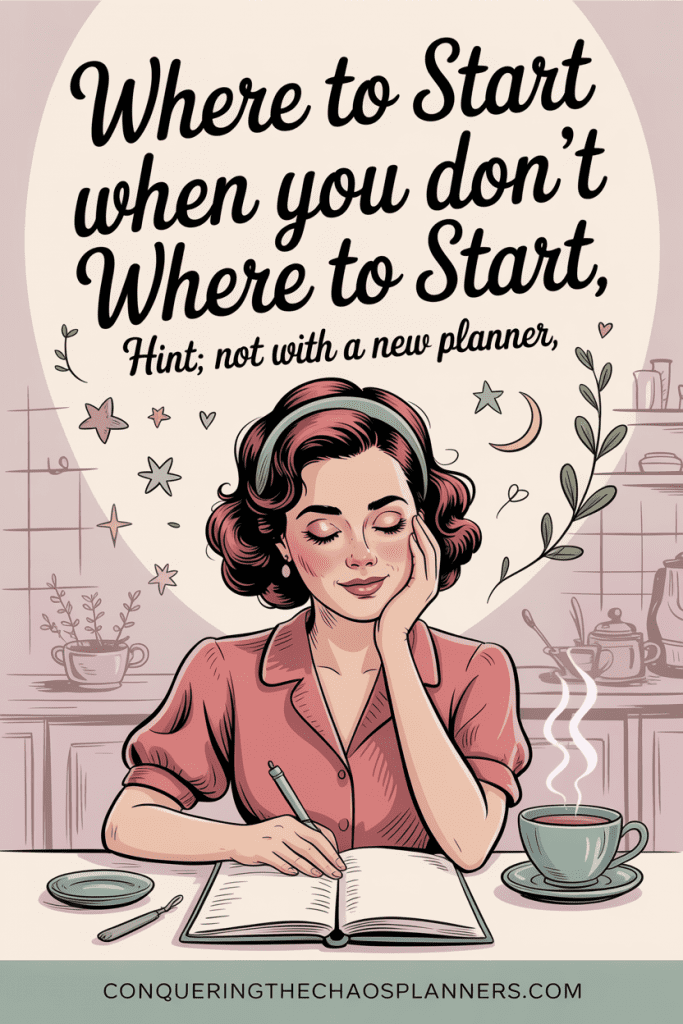
It’s 9 PM and the kids are finally in bed and you’re sitting at the kitchen table with a cup of tea you forgot to drink and you don’t know where to start.
You can feel everything that needs to happen this week. The permission slip. The thing you said you’d do for your mom. The grocery list. The work email you didn’t answer. The basketball jersey that needs to be washed. What’s for dinner tomorrow?
So you opened Pinterest. You’re looking for a planner. Or a system. Or a printable. Something that will make this feel manageable.
Same. I have been here so many times.
Here’s what I want to tell you before you spend another forty minutes looking at planner reviews: you don’t need a new planner. You need to understand what’s actually happening — because once you can see the cycle, everything looks different.
So let’s talk about the cycle.
Here’s What’s Probably Happening

You’re not looking for a planner because you love planners. You’re looking for a planner because life feels out of control and you need something to grab onto. The planner is functioning as relief. It’s not really functioning as a habit yet — it’s the thing your brain reaches for when the noise gets too loud.
That’s allowed. There is nothing wrong with you for doing this. It works, kind of. For a week.
Here’s the pattern, if you watch it long enough: overwhelm builds. You look for a planner. You set it up on a Sunday afternoon with a fresh pen and it feels so good. Things calm down for a little while. The planner slowly stops getting opened. Life keeps moving. A few weeks later — or a few months later — the overwhelm is back, and you’re on Pinterest again, looking for a different planner this time, because clearly the last one didn’t work.
I have been here so many times.
Most planning advice doesn’t address this part. It tells you how to plan when you’re already calm. It tells you how to set up your week when you have a quiet hour and a clear head. It does not tell you what’s happening when you can’t even start.
You’re not failing at planning. You’re just trying to plan from a place where planning doesn’t work yet. (If this is sounding familiar, you might also like Feeling Overwhelmed When Nothing Is Wrong — it’s a sister post to this one.)
The Smoke Detector vs. the Fire Extinguisher

Here’s the thing I want you to see.
Most of us use planners like fire extinguishers. We grab one when something is already on fire. The overwhelm is at a 9, we sit down on a Sunday, we set up the planner, the fire goes out. We feel better. The planner goes back on the shelf.
And then a few weeks later, the overwhelm is back. We grab a different planner. The cycle repeats. And somewhere in there, we start to feel like the problem is us.
But it’s not. It’s a tool mismatch.
A fire extinguisher is designed for emergencies. It’s not designed for daily use. You don’t walk around your house spraying it on the counters every morning. It sits on the wall until something is on fire, and then you use it, and then it goes back on the wall.
A planner used that way will always feel like it’s failing. Because that’s not what daily life needs.
What we actually need is a smoke detector. Something small. Something quiet. Something that runs every single day whether life is calm or completely on fire.
A smoke detector doesn’t put fires out. It catches them before they start.
It’s the difference between “I need to handle this” and “I just check in for two minutes every morning, before anyone else is awake.”
A smoke detector is boring. It doesn’t feel like much when it’s working. It just runs in the background and quietly keeps the small stuff from turning into the big stuff.
That’s what’s missing. Not a better planner. A different kind of tool, doing a different kind of job.
So the question isn’t “what’s the right planner for me?” The question is: do I have a smoke detector or a fire extinguisher? And if it’s a fire extinguisher — what would a smoke detector even look like for my life?
Sit with that for a minute.
So What Do You Do With This

You don’t have to figure out the whole smoke detector tonight. You just need to know what kind of thing it is — so you stop reaching for the wrong tool.
A smoke detector is small. Five minutes, not fifty. If you’re sitting down for an hour to do it, it’s not a smoke detector — it’s a fire extinguisher with better branding.
It’s daily, not weekly. A weekly setup is great. I do one. But a weekly setup is a different layer. It’s not the thing that catches the small stuff before it piles up.
It’s a habit, not a system. You’re not buying a thing. You’re building a tiny behavior. The behavior is the whole point. Everything else is just the container for it.
And here’s the most important part: it has to be small enough that you’ll still do it on a bad day. On the day the kids are sick and you slept terribly and you’re behind on everything. If it only works on calm days, it’s not a smoke detector — it’s another fire extinguisher in a nicer outfit.
Better to start small and keep going than to build the perfect system and abandon it in three weeks. (And if part of what’s weighing you down is everything you’re holding in your head, this post on mental load is worth a read too.)
Start Here
If you want help with this, the closest thing I can give you for free is my Sunday Setup Checklist. It’s not a planning session — it’s a setup. Five small things, twenty minutes, done before Monday hits. You can grab it here.
Start there.
(And if you ever want to go deeper on building the daily anchor habit itself — the smoke detector — that’s what I made The Planner Fix for. But the checklist is the right first step.)
