
Somewhere in your house right now is an abandoned planner you bought between six months and three years ago, depending on how recent your last attempt was. It’s beautiful. It has tabs. Maybe a folder. Possibly a sticker sheet that came with it. You spent at least 90 minutes setting it up.
If you flipped through it right now, you’d find:
- The monthly view from January, filled in for about two weeks
- The weekly view, used for a month
- A goals section, half-completed
- A habit tracker, started, abandoned by the third row
- A meal planner section: empty
- A budget section: empty
- A self-care section: empty
- A gratitude section: completely empty
If this is your house — same. I have at least three of these planners in a drawer right now.
Here’s why planners fail for most of us — and why it’s almost never because of you.
1. Every Section Is a Decision
Every section in your planner is a decision you have to make every single time you open it. Is this a goal or a habit? Does this go on the weekly view or the monthly? Is this a personal thing or a household thing? Do I track this here, or over there in the section I set up specifically for tracking it?
Multiply that by fifty entries a week and you have a planning system that punishes you for using it.
The real moment it falls apart is small. A thought hits you while you’re standing at the kitchen counter — call the dentist, the kid’s permission slip is due Friday, we’re out of laundry detergent. You look at the planner. You start trying to figure out which of eight sections it belongs in. You don’t write it down. You try to remember it instead. Then you don’t remember it.
It’s not a discipline problem. It’s a friction problem. Your planner isn’t too hard for you to use — your planner is too complicated, full stop. And friction is what kills planners.
2. The “Ideal Week” Assumption
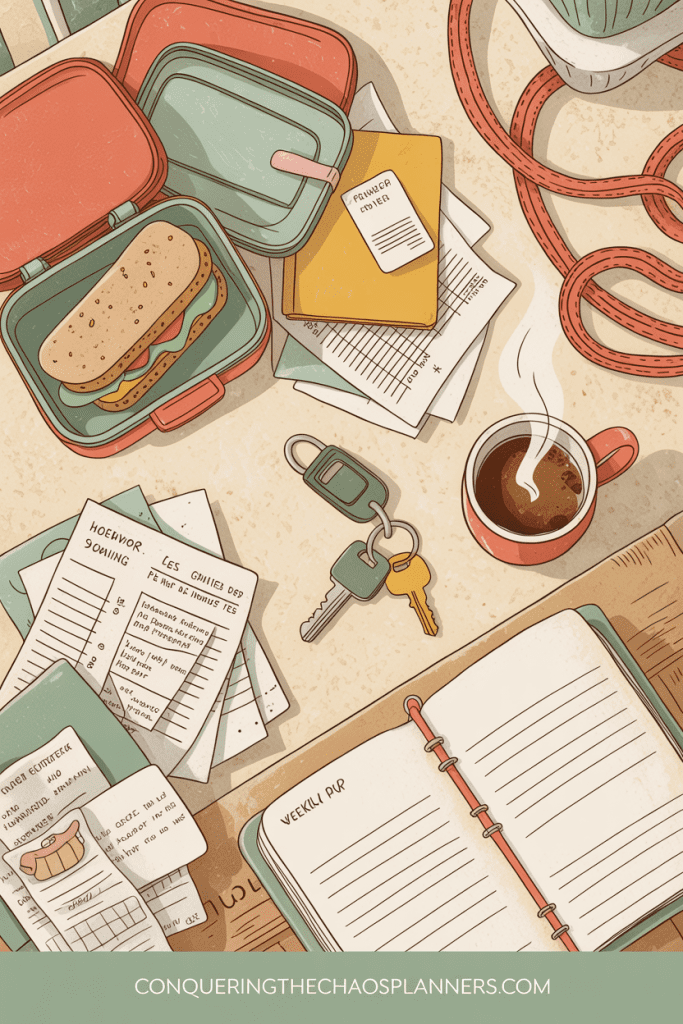
Elaborate planners are built around an idealized week. Work blocks. Exercise. Meal prep. Self-care time. Evening wind-down. A line for water intake. The format itself assumes you’ll have the kind of week that can actually fill all of that in.
Most weeks don’t look like that.
It’s the week your kid forgot her lunch and you had to drive back to school. It’s the week the work meeting ran 45 minutes long and pushed everything else into the evening. It’s the week the dog had to go to the vet. The planner was built for a calmer life than the one you actually have.
(I wrote a whole post on this called You’re Not Disorganized — It’s the Mental Load. If reason number two is hitting hard, read that next.)
When the week doesn’t match the format, you stop using the format. That’s not a planning failure. That’s a design mismatch.
3. Empty Pages Become Guilt
Every empty section in your planner is a small visual reminder that you didn’t do all the things.
The habit tracker with 18 empty rows. The gratitude journal you skipped for three weeks. The meal planner you stopped filling in around February 14th and then never picked back up. Each empty page is the planner quietly telling you that you’re behind.
Plain notebooks don’t do this. A blank page in a notebook is just a blank page. But a planner with pre-labeled empty sections? Every empty section feels like a small failure tagged with your handwriting.
The thing is — an empty habit tracker isn’t a failure. It’s a feature you didn’t need. The planner sold it to you as essential. It wasn’t. You’re allowed to ignore entire sections of a planner without it being a moral problem. That’s allowed.
4. Maintenance Costs Add Up
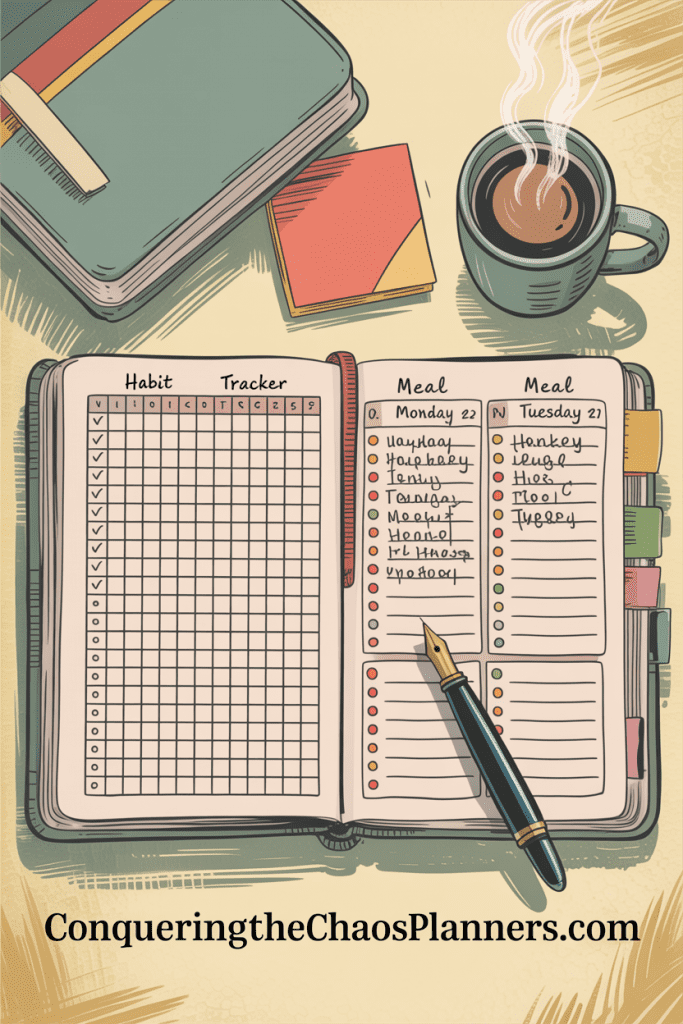
Every section requires upkeep. The habit tracker has to be marked daily. The meal planner has to be filled in weekly. The budget has to be reconciled monthly. The goals section has to be reviewed quarterly. The reflection pages want a Sunday afternoon.
Each one is small. Together, they’re a part-time job.
Every system you add to your planner is a small monthly subscription on your attention. And nobody warned you the bill was coming.
This is the reason most planners die in February. Not because you ran out of motivation — because the maintenance compound interest finally caught up to whatever bandwidth you had left after the actual life-living. You weren’t bad at the planner. The planner was expensive to run. Better to know that now than to spend another $48 finding out again.
5. The Setup Outshines the Use
The most engaging moment of an elaborate planner is the setup.
The labeling. The tabs. The washi tape. The pens lined up on the kitchen counter on a Sunday afternoon. The first-week-of-January burst of optimism where you really do believe this version is going to be different.
After that, everything is downhill. The planner peaked before you ever used it for the thing you bought it for.
By February it’s doing less for you than a sticky note on the fridge would. But the sticky note didn’t cost $48. And the sticky note didn’t come with the implied promise that you’d become a different kind of woman if you used it correctly.
That asymmetry — setup feels amazing, use feels like a chore — isn’t a quirk of any particular brand. It’s baked into elaborate planners as a category. The more the planner has in it, the more lopsided that asymmetry gets.
What This Adds Up To
Five reasons. One pattern.
Every section is a decision. Every empty page is a guilt-trigger. Every system you add is maintenance. Every setup is a peak you can’t sustain. The planner is fighting you, and you’ve been blaming yourself for losing.
Here’s the principle that breaks the cycle:
Fewest decisions wins.
Every section you eliminate is friction removed. Every empty page you avoid is a guilt-trigger you don’t carry. Every system you don’t add is attention you keep. A simple planning system isn’t a downgrade — it’s the only kind that survives a real week.
The most useful planner you’ll ever own is the one with the least in it. Call it a minimalist planner, call it a one-page system, call it whatever you want. What matters is that you’ll still be using it in March.
Start Here
If you want a planning habit that has the least possible in it — like, almost nothing, 20 minutes a week, five small things — that’s my Sunday Setup Checklist. It’s free, and it’s the opposite of the planner sitting in your drawer.
(And if you want to go deeper on building the daily version of this — the smallest possible habit, built specifically for the planner you already own — that’s what I made The Planner Fix for. But the checklist is the right first step.)
