
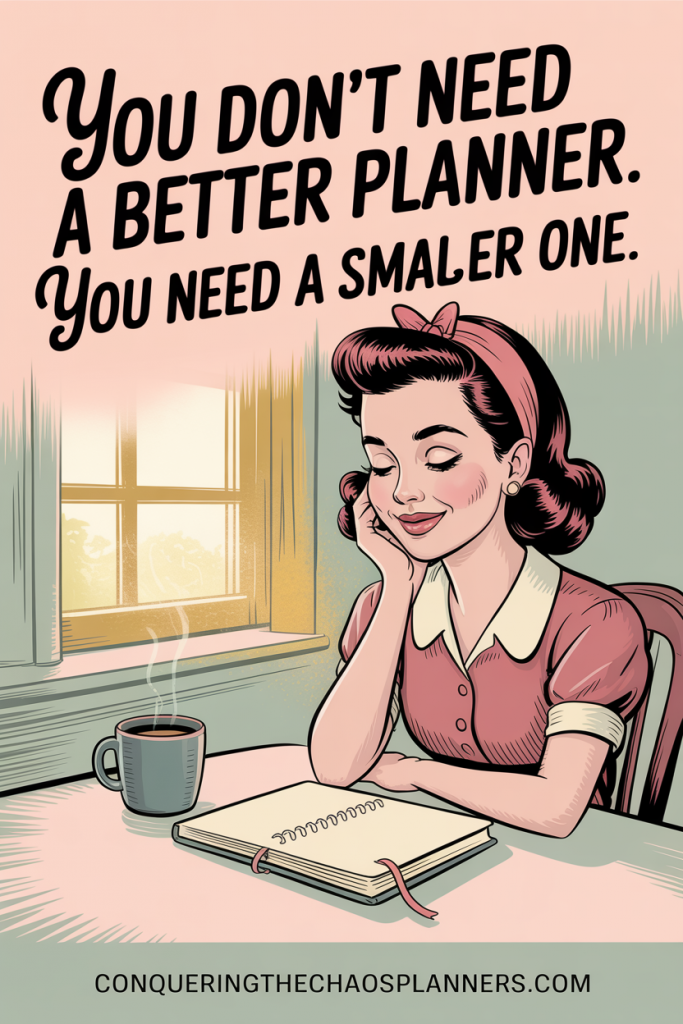
If you have spent any time looking at planners online in the last five years — and you have, because you’re reading this — you have seen the same word in every product description. Better.
The newest planner is better designed. The newest app is better integrated. The newest method is better aligned with how productive women actually think. Every system promises the same thing: this one is better than the last one. And so simple planning for busy moms gets buried under a pile of upgrades nobody asked for.
You’ve been chasing better. You’re not wrong to. Better sounds like the answer.
But here’s what I want to tell you — quietly, because nobody else is going to — better isn’t the answer. Not for you. Not for me. Not for the woman holding everyone’s schedules in her head while she tries to make dinner.
The answer isn’t better. The answer is smaller. And once you see the difference, the chase stops.
The Planning Industry Sells You “Better”
The planning industry makes money when you keep buying. That’s not a conspiracy — it’s just how the industry works. If the planner you bought five years ago still worked for you, you wouldn’t be looking at the new one. So every new launch has to promise something.
What it promises is better. Better layouts. Better paper. Better bindings. Better integrations. Better aesthetics. Better dot grids and stickers and tab dividers and habit trackers and gratitude prompts.
And better is what gets bought. Better is what fills carts on a Sunday afternoon when you’re trying to feel like next week is going to be different. Better is what shows up in your Pinterest feed. Better is what every brand sells, because better is what every brand can sell.
Smaller doesn’t sell. A $9 product that teaches you to use less doesn’t move the same units as a $48 product that teaches you to use more. Nobody is going to launch a beautiful 200-page hardback planner with a foil-stamped cover and a marketing campaign that says, “Honestly, you probably don’t need most of these pages.” That product would not pay for itself.
(I should mention — the author writing this post sells a $9 product about using less. She is aware of the irony. Stay with me anyway.)
You don’t need to feel betrayed by the planning industry. It’s doing what industries do. You just need to know that the thing being sold is not always the thing that solves the problem. Better to know.
The Real Answer Is “Smaller”
Think about every system that has ever actually worked for you, in any area of your life. Cooking. Exercise. Email. The bedtime routine for the kids that you finally stuck with after three years of false starts.
The systems that stuck were not the elaborate ones.
The exercise plan that worked wasn’t the six-day periodized program you printed off at the gym in January. It was the twenty-minute walk you took most days, the one you didn’t have to think about.
The bedtime routine that worked wasn’t the twelve-step calming sequence with essential oils and white noise machines. It was bath, book, lights out.
The email habit that worked wasn’t Inbox Zero. It was “I check at 9 and 4, that’s it.”
The dinner habit that worked wasn’t meal planning every Sunday for two hours. It was the four meals you rotate without thinking, the ones the kids will eat without complaining.
Every working system in your life has the same shape. Small enough that you’ll still do it when you’re tired. Small enough that you’ll still do it when the day went sideways. Small enough that it doesn’t require willpower or motivation or a particularly good mood. Small enough that it survives a hard week.
Planning is no different. Call it minimalist planning if you want a name for it, but really it’s simpler than that — it’s just one habit, small enough to survive your worst day.
The system that’s going to work for you is not the better system. It’s the smaller system. The one with less in it. The one you can do on a Tuesday when the dog threw up and you’re behind on laundry and you have eleven minutes before the bus comes.
You don’t need a better system. You need a smaller one. One small habit, done consistently, on the bad days too.
That’s the whole answer. The whole industry. Compressed into one sentence.
Permission to Stop Chasing

So here’s what you get to put down. You get to stop overcomplicating planning.
You can stop reading planner reviews. You can stop saving Pinterest pins of color-coded systems. You can stop telling yourself that next year you’ll finally figure out the perfect setup, the one that ties it all together. You can stop opening new tabs every time someone in a Facebook group mentions a planner you’ve never heard of.
That part is over. That’s allowed.
The chase wasn’t the problem because you weren’t trying hard enough. The chase was the problem because the thing you were chasing didn’t exist. Nobody was going to launch the better planner that finally clicked, because the better planner is not what was missing.
The planner you already own — the cheap one, the one in the drawer, the one you abandoned in February — is enough. It always was. What was missing wasn’t the right planner. It was the right size of habit to put inside it.
And the right size of habit is much, much smaller than any planner brand will ever sell you.
Pick up where you are. The planner in your drawer is fine.
If You Want the Smaller Version
If you want help building the small version — the one tiny habit that fits inside the planner you already own, built around your life, your tool, your time — that’s what I made The Planner Fix for.
It’s $9. Three short videos and a worksheet. Done in 30 minutes.
I built it specifically because nobody else was going to sell you “smaller.” Everybody else makes money on “better.” This one is the smaller version.
