
If you have ever wondered what a daily planning habit is supposed to look like — what other women are actually doing every morning that lets them stay on top of their lives — you have probably found the same content I did when I went looking.
A woman in a clean kitchen at 5:47 AM, drinking something green, writing in a leather journal with three different colored pens. Soft jazz. A candle. A view of mountains, somehow.
Or: a productivity influencer’s Notion dashboard. Twelve linked databases. A morning routine that takes ninety minutes. A reading list. A water-intake tracker. A mood tracker. A reflection prompt that asks you to set an intention for the day.
Or: an Instagram carousel called “7 Things Successful Women Do Every Morning,” which is mostly stock photos of journals and the words intentional and alignment.
Same. I have been looking at all of this for years.
Here is what I want to tell you — because nobody else seems willing to write it down. A daily planning habit, when it’s actually working, does not look anything like what you have been shown. It looks like almost nothing. And the part that looks like almost nothing is the exact part nobody posts about.
What You’ve Been Sold
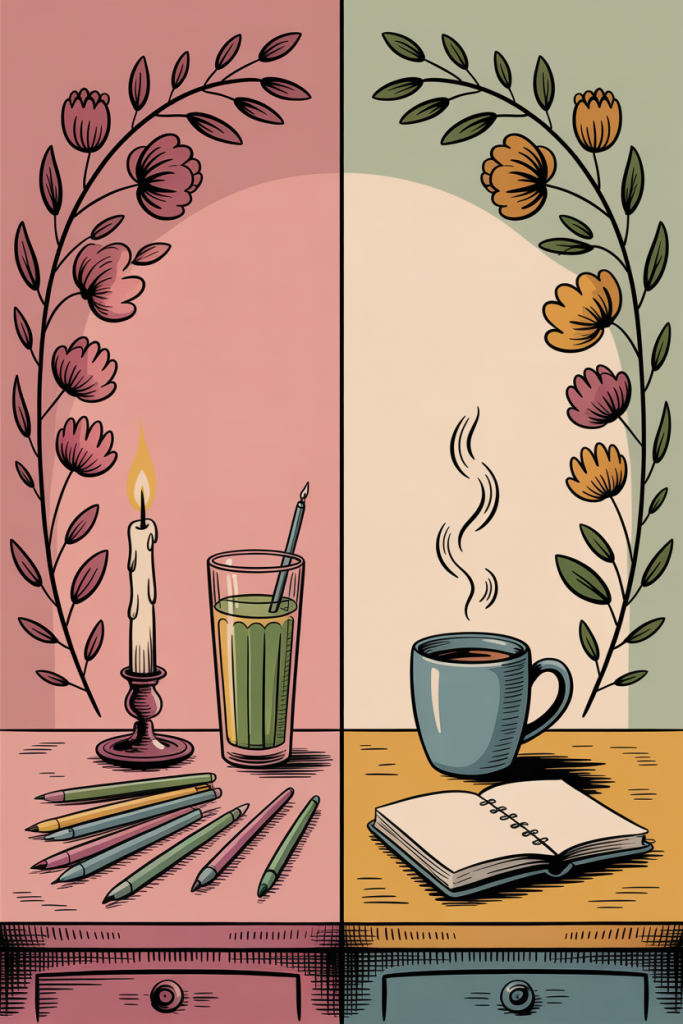
The cultural picture of daily planning is built on aspiration. It isn’t really selling you a habit. It’s selling you an image of who you could be if you had the right system — calmer, more intentional, the kind of woman who has a candle lit before 6 AM and a clear head by 6:15.
It’s a beautiful image. It’s also wildly impractical for the woman it claims to serve — which is why “how to stick to a planner” is one of the most-searched questions there is, and why none of the pretty answers ever seem to work.
The 5 AM miracle morning works for someone with a quiet life. The ninety-minute Notion ritual works for someone whose mornings aren’t interrupted by a kid who needs breakfast right now and cannot find one shoe. The aesthetic journaling spread works in seasons of life that have margin in them — and most of the seasons I’ve been in lately do not.
But here’s the part that actually bothers me. The image isn’t just unhelpful. It’s quietly harmful. Because every time you try to live up to it and it falls apart by Wednesday, you don’t conclude that the picture was wrong. You conclude that you are the problem. That you’re the one who can’t stick to anything. That everyone else has the discipline and you somehow missed it.
Not because you’re lazy. Because the picture is wrong, not you.
The real daily planning habit — the one that works for a woman carrying the full mental load of a household — does not look like that picture at all. It looks like something nobody is selling, because there’s nothing about it that would make a good photo.
Better to know.
What It Actually Looks Like
So let me tell you what it actually looks like. Not the version that gets filmed. The real one.
It happens at a kitchen counter. Not a beautiful desk with a brass lamp — a kitchen counter, with whatever the kitchen lighting happens to be. Sometimes the dishwasher is running. Sometimes there’s a cereal bowl that hasn’t made it to the sink yet, six inches away.
It takes somewhere between three and six minutes. Sometimes less. Almost never more. There is no part of it that takes ninety minutes, because a woman with a real life does not have ninety uninterrupted minutes, and any habit that demands them is a habit she will lose by the second week.
The planner is open to today. Not yesterday. Not the year-at-a-glance. Not the elaborate spread three pages back that took an hour to set up and then got abandoned. Just today.
There is no journaling. There is no gratitude list. There is no reflection prompt asking her to name her core value for the day. None of that survives contact with a Tuesday.
She has not gotten up early to do this. She’s doing it in a gap that already existed — somewhere between starting the coffee and the kids being ready to walk out the door. She didn’t carve out new time. She found a window that was already there and quietly moved in.
She doesn’t write in complete sentences. She writes fragments. Arrows. Sometimes a little box that, to her and no one else, means the thing I’m avoiding. It would not make sense to anyone reading over her shoulder, and that’s fine, because nobody is.
And when she’s done, the planner closes. It does not sit open all day on the counter, inspiring her. It goes back wherever it lives. The whole thing is over in less time than it takes the coffee to finish brewing.
Here’s the part that matters most, though. On the bad mornings — when one of the kids is sick, when she didn’t sleep, when everything is already behind before it started — she does it anyway. Maybe a thirty-second version. Maybe just the one line. But she does it.
That’s the whole game.
It’s almost nothing. That’s the feature.
A daily planning habit that requires a perfect morning isn’t a daily planning habit. It’s a fair-weather habit. And fair-weather habits are the ones you lose the first week the weather turns.
Why “Boring” Is the Feature, Not the Bug

If you read that and felt a little let down — like you came here hoping for something more inspiring, a morning ritual you could actually pin to a board, something worth posting about — I understand. I felt the same way for years. I kept thinking the answer had to be bigger and better than that. It had to be more.
It doesn’t. And here’s why boring is the feature and not the bug.
The only habits that survive bad days are the boring ones. The inspirational morning routine dies in the first week of the flu. The ninety-minute ritual dies the first time someone is up at 3 AM with a stomach bug and the next morning is a write-off. The aesthetic spread dies the first season of life that doesn’t leave you the energy to make anything aesthetic.
A boring habit doesn’t die, because there’s nothing in it to lose. There’s no streak that feels ruined the moment you break it. No production value to maintain. No mood you have to be in. It asks so little of you that there’s never a good reason to skip it — and so it just keeps showing up, on the good mornings and the terrible ones alike. That is what consistent planning actually is: not a better morning, just a smaller one that survives every kind of morning.
The most overlooked feature of a planning habit that actually works is that it is not exciting. You wouldn’t film it. You wouldn’t post it. You wouldn’t recommend it to a friend over coffee, because there’s nothing impressive to describe. And that — exactly that — is why it lasts.
Pretty doesn’t survive a bad week. Boring does.
The unglamorous answer is almost always the one that’s still standing a year from now.
If You Want the Built Version
If you want the boring, built version — a daily anchor habit constructed specifically for the planner you already own and the life you actually have — that’s what The Planner Fix is.
It’s $9. Three short videos, one worksheet, done in about thirty minutes. The whole thing is designed to be boring. That’s the point.
I built it because the cultural picture of daily planning is set up to make you feel like the problem. The actual habit is much smaller, much quieter, and much more achievable than any morning routine you have ever been sold — and once you’ve built it, you stop chasing the picture entirely.
